
Gaines Township Directory Collections
Gaines Township is a charter township in Kent County. That means no municipal city roll exists for it. The useful shelf is regional and county-wide instead. The Library of Michigan directory guide sorts out the Polk, street, telephone, and criss-cross formats published around Michigan. Titles can mislead. A volume stamped Grand Rapids or Kent County may still hold a Gaines address or a Gaines household inside. Publishers used different fields, so the volume itself decides whether an address, occupation, or owner mark appears, not the title on the spine.
| Collection | Years | Where held | Access |
|---|---|---|---|
| 1870 Kent County history and directory | 1870 | Library of Congress | Free public-domain scan |
| Polk and other city directories | Late 1800s onward, exact Gaines run not located | Library of Michigan and KDL databases | Print, microfilm, or library-conditioned access |
| Grand Rapids street-address volumes | 1955–1960 | Library collections identified by the Library of Congress | Consult the relevant volume |
| Grand Rapids and Kent criss-cross volumes | 1946; 1972–1996 | Library collections identified by the Library of Congress | In-person or collection access |
| Grand Rapids Press Historical Archives | 1893–1970 | Kent District Library | Onsite at a KDL branch |
The gaps here are real. No Gaines-specific Polk shelf run is established, and no entry-level scan transcription sits in this set. A missing result means little by itself. Change the edition, the spelling, the address form, or the custodian before concluding a family ever left Gaines Township.
KDL Access for Gaines Township Directories
The Gaines branch of Kent District Library is a practical base for directory work. It offers public computers, free printing, Wi-Fi, a local-history room, and a meeting room. Listed hours run Monday, Tuesday, and Thursday from 9:30 to 8:00. Wednesday, Friday, and Saturday hours are 9:30 to 5:00, and Sunday is closed. The branch sits at 421 68th St SE in Grand Rapids. Its published phone is 616-784-2007. Check the branch page before any research trip, since hours and access conditions shift. Once a directory name or address surfaces, move to KDL's history and genealogy resources. KDL lists Ancestry Library Edition. It also lists MyHeritage, HeritageQuest, History Reference Center, and the Grand Rapids Press Historical Archives. The press archive spans 1893–1970 in full text and works as an onsite branch resource. It can date a move, an obituary, or a road notice. It can also pin down a school reference or a township event. That context turns a bare directory listing into a story. See the official Gaines branch page for the local-history room and access details. Make the library a Gaines Township city directory research stop once you have checked access.
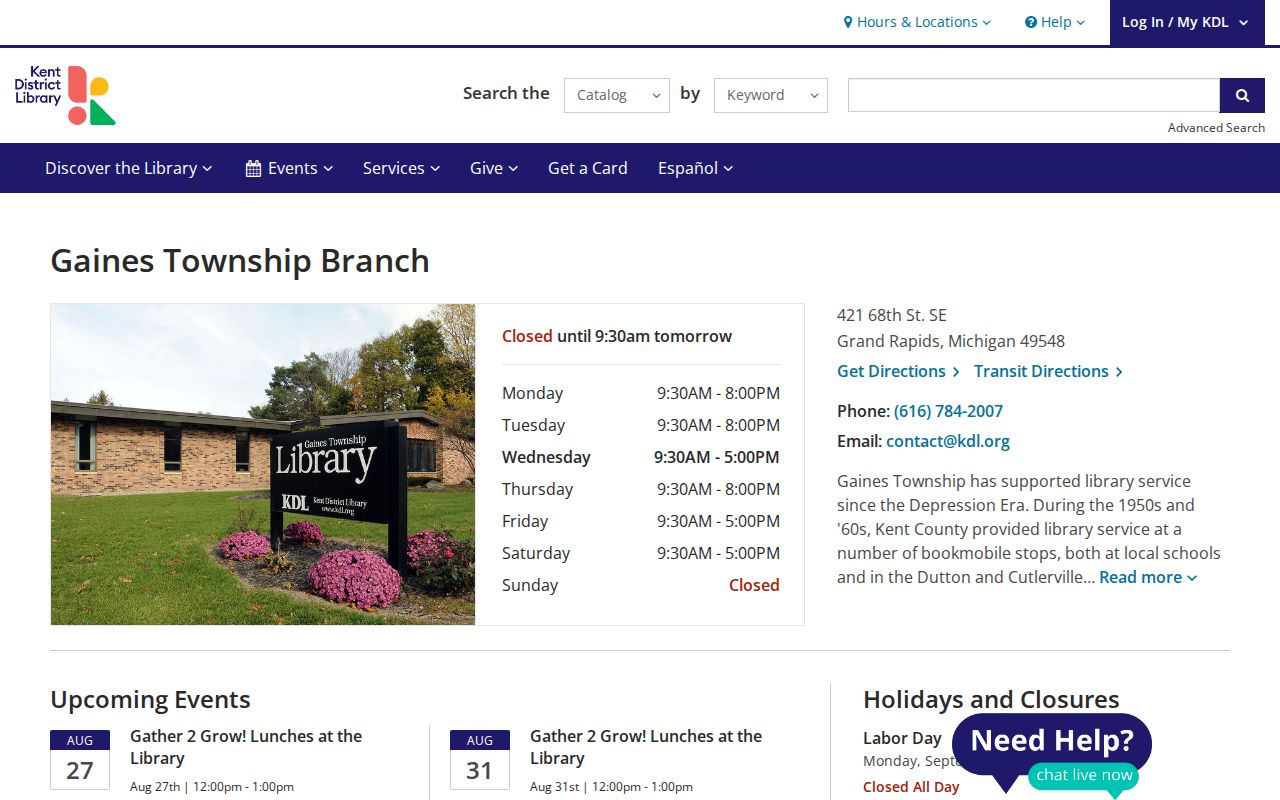
The branch puts historical directory work, computer access, and local help under one Gaines Township roof. Newspaper searching stays bound by KDL's onsite condition.
1870 Gaines Township Directory Clues
The digitized 1870 History and Directory of Kent County is a landmark for early Gaines Township research. It stands as the clearest early source. Dillenback & Leavitt's volume blends township history with names, locations, and post-office material. It covers residents outside Grand Rapids. It places Gaines as town 5 north, range 11 west. The scan preserves an era long before modern address searching. So it works as a dated starting point rather than a current resident list. Its Gaines narrative records Old Gull Road's earlier zig-zag route. It also notes the road's later straightening along section lines. It further notes the 1854 plank road and Burlingame's 1852 mill in section 18. Those details matter for family stories. An old road description may be the only clue. The source names historical Gaines people too. Treat surnames as search terms for later material, never as a claim of current connection. Open the Library of Michigan directory guide before picking a format. The Gaines Township city directory format should fit the question.
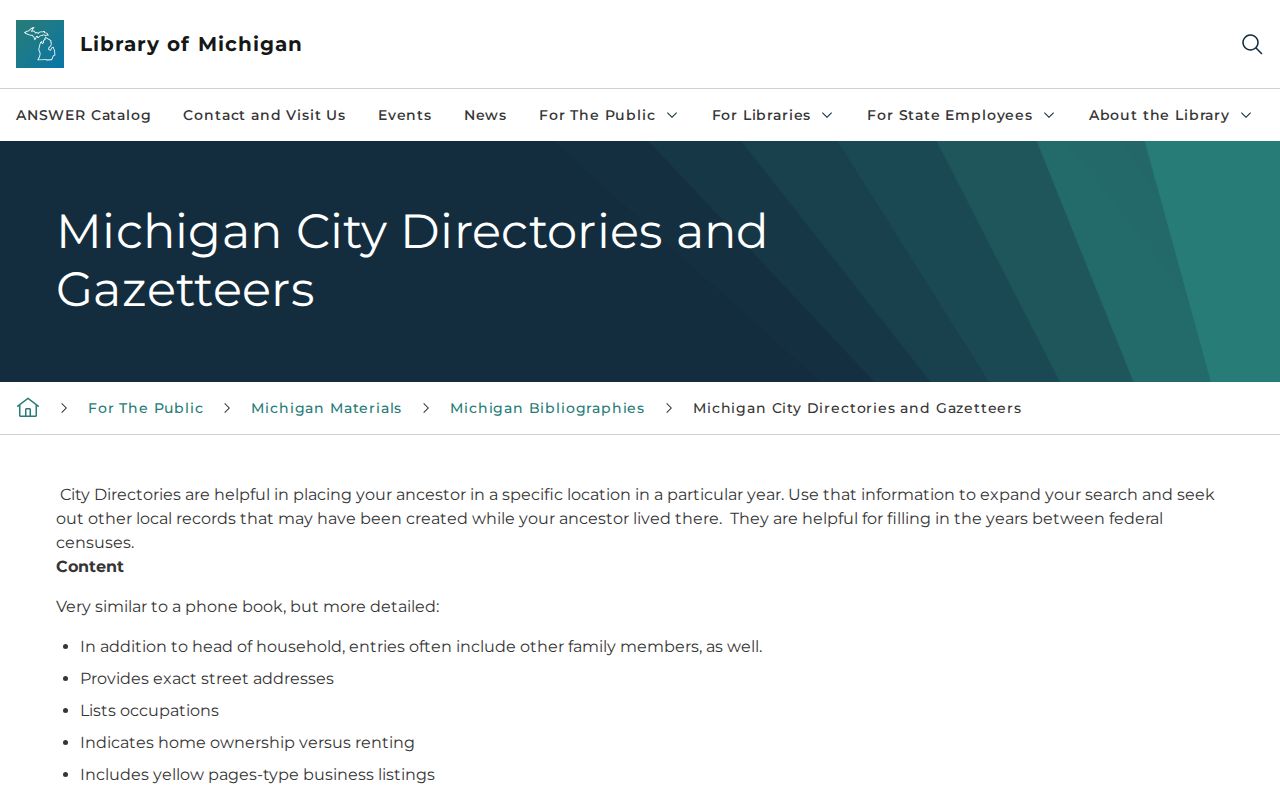
The Library of Michigan guidance separates a surname directory from a street section and a later reverse-address book. Knowing the format prevents a false match from one layout being carried into another.
Reading a Gaines Township Directory Entry
Read each city directory entry as a dated publisher record. Polk surname sections may carry an address and an occupation. Some add household members and a publisher status mark. A telephone book had a different purpose. It may show only a subscriber and nothing more. The Library of Michigan cautions that the exact field set varies by volume. Before copying a name, photograph or note the title page. Also note the publisher, year, and the abbreviation key.
| Name | A listed person or, in some editions, the head of household. |
|---|---|
| Street and number | The address as printed in that edition, which may use an older form. |
| Occupation or business line | Publisher-provided context that must be read with the edition date. |
| Publisher status mark | Available only in certain directory formats and editions. |
| Phone or relocation clue | Possible in later criss-cross and telephone material, not guaranteed. |
- Criss-cross directory
- A reverse-format book arranged by street and house number, useful for following an address rather than beginning with a surname.
- Householder index
- A list that may favor the first named adult at an address and may leave other household members unlisted.
- Abbreviation key
- The publisher's explanation of shortened terms and symbols, often found near the front of a volume and essential for a reliable reading.
Never stretch a printed name into a broader claim. A directory shows that the publisher tied a person or household to an address in one edition. It cannot prove the full household, legal ownership, or a present-day location. Those require a separately dated record.
Criss-Cross Gaines Township Directory Years
Start with the house number. The Library of Congress criss-cross guide charts address-first volumes for Grand Rapids and Kent County in 1946 and again from 1972 through 1996. Its street-address guide adds Grand Rapids books covering 1955 to 1960. Those spans are real but limited. A publisher may have served a wide commercial area. So no single edition promises that every Gaines Township street appears inside. Treat the dates as windows to check rather than guarantees.
Later editions from Bresser's and similar publishers often fold telephone listings together with street sections. One entry can flag a head of household, a phone, a first listing at an address, a newcomer, or a departure. Match the street spelling used that year. Then line up the following edition to spot changes. The full by-address method lives on the Gaines Township street directory page; these older books add the historical layer beneath it.
Note: Street, telephone, and criss-cross sections can describe the same area differently. So record the book title and edition date beside every result.
Tracing Families in Gaines Township Directories
A Gaines Township family trail works best when it is built from dated sources rather than one lucky name match. Begin with the earliest entry you can pin down. Follow the household forward edition by edition, then test each address shift against a census page, obituary, cemetery record, deed, or local-history item. Not every change means a move. A vanishing name might reflect publisher coverage, a missing volume, a household shift, or plain spelling drift. The directory date is what sorts those possibilities apart. That is why a Gaines Township residents directory search always keeps the edition year in view.
- Record the person's name, address form, directory title, edition year, and every symbol exactly as printed.
- Check the next available Gaines-area volume for the same surname and for a street-order entry at the prior address.
- Pair directory years with the nearest available census or state-census period, while keeping the sources' different dates clear.
- Search the KDL press archive for a move, obituary, civic notice, or township reference that may explain a gap.
- Use a parcel or deed record only when the question shifts from a household listing to a documented property trail.
The Archives of Michigan guide widens the trail with tax assessment rolls from 1872 through 1940, state censuses from 1884 and 1894, cemetery files, naturalization papers, court records, and voter-related series. These are Kent County custody leads. Confirm the township, range, volume, and index before treating any series as Gaines-specific.
Kent History Sources Beside Directories
Beyond the residents directory trail, the Kent County Historical Society research library holds manuscripts, ledgers, maps, family genealogies, and cemetery records. It also keeps photographs and oral histories. Visits run by appointment. Its separate archives were still being inventoried and catalogued through at least 2025, so a promising subject may not sit on a ready shelf. The PastPerfect catalogue allows keyword searches, quoted phrases, and advanced search. Alphabetical browsing is also available. A hit marks an item or lead rather than a guaranteed digital image. For appointment or collection questions, the Historical Society lists its staff research contact at director@kentcountyhistory.org. That contact earns its keep. A Gaines Township directory address may point toward a cemetery, family paper, map, or local photograph.
Before matching a Gaines directory name to a dated notice, check the full database list. The newspaper and genealogy databases sit on the KDL history resource page.

The KDL archive route pays off once a directory has supplied a name, an address, or an approximate period to carry into a dated newspaper record.
When Gaines Township Directories Fall Silent
No official Gaines municipal resident directory is published. That is a real limit, not an invitation to guess. A city directory can skip rural routes and unlisted people. It can also miss households outside its circulation area. Anyone the publisher never collected will be absent too. When one shelf runs thin, other channels stand ready: the Library of Michigan's second-floor South print and microfilm routes, online library resources, KDL access, the Historical Society, and the Archives of Michigan Kent County Guide.
Keep each source's purpose in view. A directory reflects a publisher's listing. A tax roll tracks assessment. A deed names the parties to a recorded instrument. A voter file follows its own date and access rules. Family history, estate questions, and local history are the right uses for names and addresses. Never use any result to stalk, harass, or harm a person. Keep the source, date, and custodian visible beside every finding.